 Hit your stride
In the name of "notes," you're building digital debt across OneNote, Drive, and Telegram.
Your notes are a pile of isolated facts. The connections exist only in your memory. That's invisible labor you can avoid.
When the exam asks about Centre-State relations, your brain does archaeology. Governor walkout — that was November, right? Article 176 — August? Punchhi Commission — April? Did I connect them? Where?
Your notes don't know they're the same story.
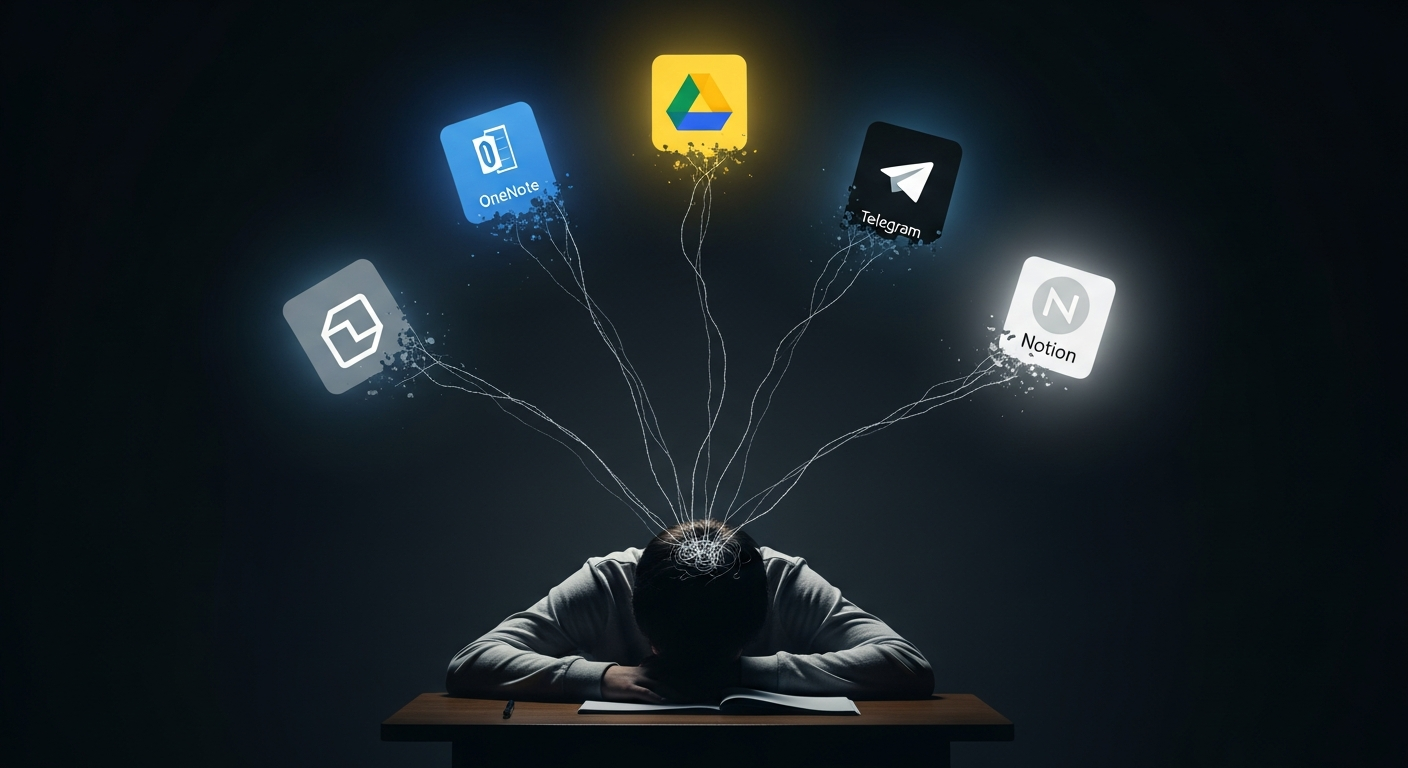
"Your brain is the only database."
How Notes Vault works
Your knowledge isn't linear. Your notes shouldn't be either.
Notes Vault doesn't store documents. It builds a knowledge graph — automatically. Every article you add doesn't sit in a folder. It becomes part of a living graph.

"The Punchhi Commission appears in 4 articles across 6 months. Your brain doesn't remember that. The graph does."
What Notes Vault does
Intelligence, not storage.
Ingest Once, Connect Forever
Upload a Recitals PDF. Vault reads it, decomposes it into articles, extracts every concept, issue, and anchor, and wires it into your existing graph. One upload. Hundreds of connections. No manual tagging. No folders. No filing.

Revision in One Tap
Open "Fiscal Federalism." See every article you've read about it, every issue it's appeared in, every anchor it connects to — synthesized into a clean, exam-ready narrative. Revision isn't hunting. It's one tap.
Open Issues = Exam Predictors
See every issue still unfolding — Governor controversies, pending SC cases, policy debates. These are what UPSC asks about. What's unresolved now is what appears in the exam next. Vault keeps score.
Timeline View for Every Issue
When an issue opens, Vault tracks every article that continues it. By exam time, you have a complete narrative arc — when it started, how it escalated, where it stands. UPSC mains answers need narrative. Vault builds it automatically.
Cross-Reference Without Thinking
Every time you add an article that cites Article 176, it connects to every other article that cites it. Instant cross-reference. Constitutional articles. SC cases. Committees. Conventions — they're nodes, not tags.
Not Notion with better templates
Notion is a filing system. Vault is a knowledge graph. Your notes don't sit in folders. They connect to each other.
Not a PDF highlighter
Vault doesn't store PDFs. It reads them, breaks them apart, and weaves them into your understanding.
Not passive storage
Google Drive stores. Vault thinks. It knows what connects to what, what's stale, what's unresolved, what you haven't touched in 60 days.