 Hit your stride
Six AI agents serving one 'master'. One full-length answer sheet up to 50MB. Deep evaluation.
Answer Evaluation Agent is an agentic evaluation system for UPSC Mains — specialist AI agents that verify your facts, interpret your diagrams, read your handwriting, and evaluate your argument like a panel of examiners would.
The AI-led organisation of work
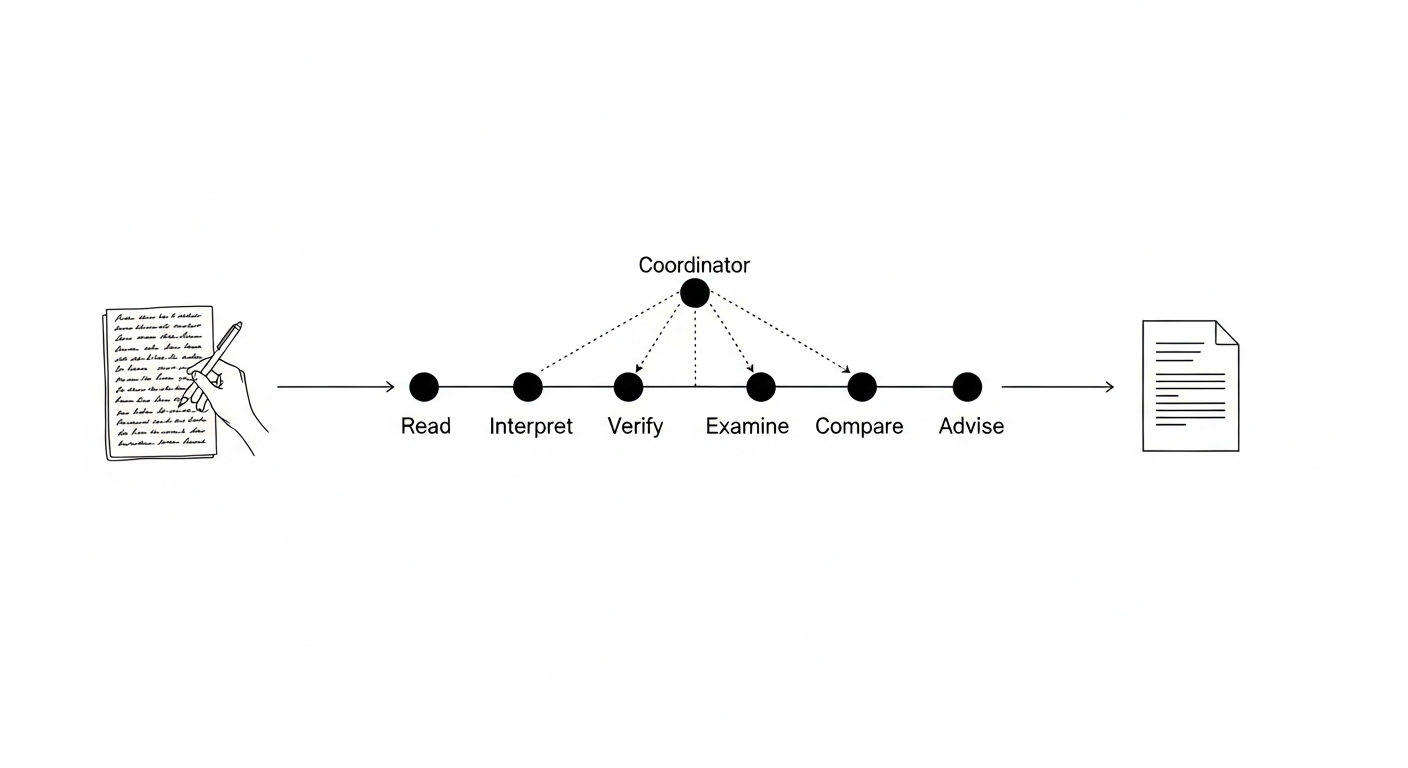
AI using division of labour
The Reader
Handwriting & OCR
Reads your handwriting using sentence context and subject domain to resolve ambiguous characters — not just raw pixel recognition. You can preview extracted text before evaluation begins.
The Diagram Interpreter
Visual Reasoning
Doesn't just acknowledge your flowchart. Reads what's inside it, checks its accuracy, and evaluates whether it strengthens or weakens your argument.
The Fact-Checker
Claim Verification
Extracts every factual claim — dates, names, article numbers, committee titles — and verifies each one individually. Errors flagged with corrections, not summarised.
The Examiner
Argument & Directive Analysis
Evaluates whether your reasoning holds, your directive is followed, and your examples — even unconventional ones — actually support your point. Not keyword counting.
The Benchmark Analyst
Topper Comparison
Compares your answer structure, coverage, and argument quality against high-scoring answers for that question type — tells you the specific gap, not a vague score.
The Mentor
Actionable Feedback
Not 'improve analytical depth.' Instead: 'Cite the CAG audit on MGNREGA, connect it to fiscal federalism, and drop the third scheme — it weakens your argument.'
Others do this. We do this.
Other tools won't catch that you wrote "Sarkaria Commission (1988)" instead of 1983.
Fact verification, not fact assumption. Every claim — dates, names, article numbers — extracted and verified individually.
Upload a 30-page booklet. Other tools reject it, time out, or evaluate each page in isolation.
Full mock tests, fully evaluated. Our document agent maps question boundaries across pages — Q5(b) spanning pages 19–21 is read as one answer.
Other tools either ignore your diagram or say "Good use of visuals."
Your diagrams, actually evaluated. The visual-reasoning agent reads the content, checks accuracy, and evaluates whether it strengthens your argument.
Standard OCR reads "rights" as "nights" then evaluates silently as if you wrote something else.
Handwriting intelligence, not just OCR. Context and subject domain resolve ambiguous characters. Preview extracted text before evaluation.
A keyword-matcher doesn't find "Stockholm Conference" on its checklist, so it says "add more examples."
Argument evaluation, not keyword counting. If your reasoning holds and your examples support your point, we say so — even unconventional ones.
Generic feedback: "needs more depth," "add examples," "improve structure."
Feedback you actually learn from. Two aspirants, same question — completely different, specific feedback for each.
What it is not.
No 60-second evaluations.
Six agents take 2-3 minutes for 20 questions. That's what reading actually costs. If your current tool scores a full mock in under a minute, ask what it skipped.
No scores.
We can evaluate your argument, verify your facts, and tell you exactly what to fix — but we can't replicate UPSC's internal scoring patterns and won't pretend we can.
Feedback that teaches.
There's a difference between "needs more depth" and "cite the CAG audit findings, connect it to fiscal federalism, and drop the third scheme." You'll learn something.
Honest about limits.
If we can't read your handwriting on a section, we'll say so — not guess and evaluate a hallucinated version. If a diagram can't be interpreted confidently, you'll know.
See what six agents find in your answers.
Upload one answer — handwritten or typed. No account needed for the first evaluation.